Tuesday, April 15, 2008

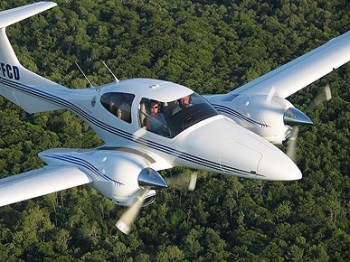
Piper Seneca on Multi commercial

Who says the Senecas are old, ugly and bad to fly? Well, there might be a little truth on the first adjective, old. But that's all, the old ladies are beautiful and so nice to fly!

I am lately working on improving my flight skills - doing things I've done before, like visual approaches, steep turns, slow flights, VMC demos, Instrument approaches, single engine patterns, diversions, and more. Yes, it looks like a waste of time and money but it's actually good I guess. First of all you improve your skills. Second, you get more experienced with the plane and with VFR flying, as you are applying for a commercial license with just a little more than 120 flight hours. Third, you get confident, so confident! Yes, experience makes you confident, point. I feel lately that I finally "got used to flying", it looks normal and so natural for me now. I don't get nervous anymore during a simple take-off or a controlled stall, or during bumpy conditions. I don't get anxious before the flights and I can sleep well the night before. The cockpit environment, during my private was so full of mixed feelings like tension, pressure, fun, joy and even fear at sometimes, now starts looking more comfortable, like your new office.


Yeah, I am starting to like this idea.... waking up, having your breakfast, taking your flight bag and heading to the airport, checking the weather and W&B at dispatch, going to the plane for another flight, and another and another.... Sounds too good to be true!
Even simulated emergencies are handled almost automatically, you perform the checklist items like a robot. Yeah, it's becoming a profession, I guess...

Have a nice week, and Pessach Sameach!


Thursday, April 10, 2008

Instrument movie

I made a new movie about my Instrument Course in Daytona Beach, finished on february 2008. Enjoy it!

Saturday, April 5, 2008

Flying commercial


Yeaaaaaahhh, finally after 2 long weeks of waiting, I got my temporary license and started flying the Seneca again, this time for commercial!
Looks pretty much the same, some maneuvers, some VFR navigation and diversions, actually you feel like having a "deja-vu". The difference i think is the approach to flying the plane, the responsibility, the decision-making, the subtle way of flying, having people paying you in the back.

Mostly, pretty much fun flying VFR freely again!!
Hope to post more pictures soon... peace in the skies.

Monday, March 24, 2008

Waiting, waiting, wating....

I read on the newspaper last week that Florida is packed with foreign student pilots. Mostly people from India and China, consequence of the big-aviation-boom in those countries in Southeast Asia, are streaming to the sunshine-state skies to earn their wings and then go back home.
Add that to the fact that the US dollar have never been so low in the whole world.... What a perfect combination for wannabe pilots.

Well so far it looks like good news right? The local economy enjoys this grow as well: student pilots fill restaurants, go to clubs, buy laptops, rent apartments, even buy cars. Needless to say about flight school owners, popping their champagnes after every new aircraft that joins the expanding fleet. However, that's bad news to us pilots! We wait between flights, more planes are grounded, all instructors are busy as hell, lack of airplanes, lots of cancellations and the list goes on. Not to mention the mess in the skies, the sharp watch out for traffic, the endless waiting on the hold short line before take-off, the numbers in the hobbs rolling in the ground while your heart burns as you feel your money burning too...

Yeah it's been a pain. Also for all part 141 students, we have a lot of stage checks - those are mini-checkrides inside the school, after every stage of your course. And what happens is that the average waiting time between your last training flight and a stage check is about a week, so imagine what happens when you do your instrument rating where you have 3 stage checks and one final checkride. That's about 4 weeks of waiting, doing nothing. Students are getting bored and desperated.

I didn't mention the paperwork between courses... It's also about a week of waiting after you finish one course/rating and want to start a new one. You need to get your temporary license, and it passes trough about 7 different people to check it and sign it, so in average one person a day can check it because "everyone is so busy in school" and then.... hell!

Until when??

Monday, March 10, 2008

A lesson on Multi-Engine

Hopefully this week will be the last on Multi-Engine, I've been studying a lot for my End-of-Course. I can start to feel the anxiety to start flying commercial!

Because I had nothing very interesting to post here this week, I thought useful to share here a bit of my studies. Anyone interested in a multi-lesson? Well if you are here reading this and have the odds for the nerdy-flying stuff or has nothing better to do right now, you might wanna take a shot:


VMC

"Vmc is the calibrated airspeed at which, when one engine is made inoperative, it is possible to maintain control of the airplane with that engine still inoperative, and thereafter maintain straight flight at the same speed with an angle of bank no more than 5°."

The method used to define or simulate the critical engine failure (Vmc) must represent the most
critical mode of failure with respect to controllability according to FAR 23.149.

Conditions by which Vmc is determined by the manufacturer for certification:
I. Standard Atmospheric conditions exist
II. Most unfavorable CG and Weight
III. Airborne and out of ground effect
IV. Critical engine inop.
V. Bank no more than 5° in the good engine
VI. Max takeoff power
VII. Trimmed for takeoff
VIII. Flaps in takeoff position
IX. Cowl flaps in takeoff position
X. Landing gear retracted
XI. Inop engine windmilling
XII. Rudder force to maintain control must not exceed 150 pounds
XIII. Must be possible to maintain a heading +/‐ 20°

The Critical Engine:
"Critical Engine is the engine that will produce the most undesirable effects on the airplane when suddenly made inoperative."

• Four factors that determine critical engine
1. P – P‐factor
2. A – Accelerated airflow
3. S – Spiraling slip stream
4. T‐ Torque effect

Monday, March 3, 2008

A view from the pilot's seat

For those who still were not there, I introduce you the view from the pilot's seat of a Piper Seneca, over the beautiful Florida shoreline. One picture worth one thousand words.

If you were getting used to my pictures on the C172 with the G1000, well things have changed a little bit... Now we have 2 engines, but back to the old 6-pack gauges, and believe me when I say old, that's because it's really old :)

Take a quick look in the cockpit, see any differences? "Yeah, some LCD screens appear to be missing..."


This week I also had a happy visit: Chen, old mate from Private Pilot home base back in Israel, came from Washington on a long cross-country and stopped at KDAB to say hi! And here is the picture, posted for the posterity. From Meggido to Florida, slowly climbing the stairs of the long aviation career...


Friday, February 22, 2008

Flying the Multi


I present you the Piper Seneca, an old warrior. More than 30 years in service, most of its instruments inoperative. Some bolts in the cowling fairing missing here and there, but nothing to worry too much about. I'll quote here my instructor comment about the exterior preflight inspection of the engines: "You shake it a litte bit, if the engine doesn't fall, it's good to fly"
:)

I have another interesting quote from one of the MEI students: "To fly the Seneca, you just have to lower your standards".

Well, wether it's old or part-functioning, it's certainly much fun! Today we've been practicing some engine failures, and single-engine approach and landing - a lot of work, but a lot of fun!

Sunday, February 10, 2008

Instrument Rated, finally!

Yeahhhhh it finished today, after almost 3 months of approaches, holdings, interceptions and trackings. We started already Commercial Pilot ground school, and we hopefully will start flying some VFR finally.

Hope Ill have more time to post here more often... Have a good week everyone!

Saturday, February 2, 2008

Getting some actual!

My last XC: KDAB - KTLH - KCRG - KDAB, totalling 5.2 hours!
Well, Tallahasse is really far from Daytona, it's a little more than a 2 hour flight in a C-172. You get there and start streching yourself, not mentioning the huge urge to pee. Yeah, I learned that Gatorade it's not a good idea in flight. Living and learning...

First time of Actual IFR, it's so amazing to fly over the top, and then break the clouds to approach the runway! Certainly a privilege not every Instrument student gets... See some pics, they talk for themselves.


Cumulus formation embedded in the middle of a stratus overcast layer.

How it feels in the G1000 at 7000 MSL...


And seeing the sunset over a overcast layer at 7000 ft... there is no price for that!


...finally at the Fancy FBO in Tallahassee. They have internet with MSN, 5-star-hotel restrooms, a pool table, and even delicious free cookies over there, you should try some!

Monday, January 21, 2008

DAB-ISM-DAB

Today was my first IFR XC, we flew from Daytona to Kissimmee, FL.
It was all well planned, the flight plan, the weather, all by the book. All the calculations, everything was there - until I heard the expected IFR clearance "You are cleared direct to KISM, expect radar vectors". Damn it! After meticulously filling the flight plan form, spending more than 1 hour using the E6-B 1000 times, thinking about headings and wind corrections.... all to the waste bin :))

The flight itself was gorgeous, not IFR all the way, but there were some clouds and some pretty bad haze on the way back. Flying the glass is such a joy.... autopilot ON, and the camera starts looking for good shots. We flew over Disney World, but I couldn't really identify any roller coaster :)
Next XC is going to be looooong, I am going to Tallahassee - that's almost 5 hours both ways!!

Enjoy the pics...

A view from Lake Louise "at 4 o'clock".

On the way to Kissimmee at 4000 ft, under a high ceiling.


Wednesday, January 9, 2008

Part 141, stage 3 IFR


After some basic instrument skills on stage 1, complicated clearances and approaches on stage 2, here comes stage 3! The nice and long cross-countries, hearing music on the G1000 :))
I can't wait!!

Many jets are coming to Daytona these days, it's the beginning of the NASCAR season. It seems like in the end of the month, all the jets are going to expel us from our ramp!


Well, so far we have some space at the Sheltair Ramp, our home base @ KDAB.

Friday, January 4, 2008

Landing with Wind Gust


Since my Private License, I never really landed with more than 15 knots head or 12 knots crosswind and of course never with strong gusts. This week though, was a very strange week in Daytona: sudden cold front, with very high pressures and even snowed in Central Florida! I don't think it ever snowed in Florida, not at least in the last good 10 years... My altimeter setting today was 30.65 and the temperature at 4pm was around 3C ! But the most interesting thing was the wind gust: we took off with 16G27, 45degrees from the runway centerline. That was certainly a great and challenging flight experience!

I don't have to tell the whole flight was turbulent and messy, now imagine yourself flying the G1000 at night and trying really hard to read the numbers on the airspeed and altitude tapes because the airplane at 2500 ft MSL only wouldn't stop shaking! I think it felt like being in a constant earthquake. Tiring, but very good instrument experience!

Here are some pics... enjoy and have a nice week everyone.